Showing posts with label Environment. Show all posts

1/6/14

Gov. Snyder (MI-R) – Caught Between ALEC and a Dark Place

by Amy Kerr Hardin  


It’s been two weeks since Gov. Snyder announced his new energy plan for Michigan, and sides are already being taken, but this time there appears to be a middle ground — a phenomenon of which, like Brigadoon, appears magically only every four years.

The governor carefully qualified his policy initiative with no promises that any positive relentless action would occur anytime soon. MLive reports:
Snyder said he hopes to have legislation in place in 2015, which is when the state’s current renewable energy and energy efficiency programs end. He said it’d be difficult to pass a comprehensive energy policy in 2014 since it’s an election year.
In his pre-Christmas policy statement, Snyder told the press that he intends to emphasize renewable energy and a curtailment of the state’s reliance on coal. Ironically, he also emphasized the importance of the stability of the power grid and a policy goal for the reduction in the number of, and duration of power outages — just hours before the state’s capitol was plunged into darkness for a hellish week of cold and misery while the governor enjoyed a safe warm holiday with his family. 

Lansing residents are in no mood to hear about a 2015 solution.

A huge sticking point will be Snyder’s support of fracking in the state. This issue is an absolute non-starter for many clean energy advocates. They gnash their teeth when they hear the governor claim that Michigan is “a role model for fracking done right”. Even a modest centrist would have to admit that the Great Lakes region is the worst possible place to test the long-term effects of the latest fracking technologies. The risk is simply too great.

However, it’s not all doom and gloom. It is likely that, not by sheer coincidence, just a few hours prior to the unveiling of the new energy policy, Wolverine Power Supply Cooperative announced they were scrapping a proposed 600 megawatt coal-fired power plant in Rogers City. They had been fighting for the plant since 2006, making the “clean coal” sales pitch — a claim which makes even the most mild-mannered environmentalist want to hurt somebody real bad. The Environmental Law & Policy Center expressed relief that the project was canned, citing the dirty truth about “clean coal”:
 According to the plant’s air permit, Wolverine would have added 995 tons of particulate pollution, 1,344 tons of SO2 pollution, and 2,647 tons of NOx pollution annually. The company also proposed releasing 46.8 pounds of mercury pollution, which will end up in area lakes and rivers; 700 pounds of lead, and more than 6 million tons of greenhouse gases including carbon dioxide.
Okay, so our air will be that much less polluted…

Yet, will centrist Republicans ever again be able to attract the kind of support necessary for a meaningful energy policy? Or are the golden years of Bill Milliken never to be revisited by the Michigan GOP?
Mich. Conservative Energy Forum FB pageClaiming the center ground on energy policy will not be easy for conservatives. And they aren’t off to an impressive start. They launched their social media in mid-December and are struggling to gain a following. Their facebook page, titled Michigan Conservative Energy Forum, isn’t exactly catching fire with 88 “likes” as of this writing.  Their mission statement sounds reasonable enough though, yet it will certainly garner detractors from both the left and the right.
The MCEF is a newly formed organization of MI conservatives who believe that the state must transition to clean, renewable energy sources.
MCEF Mission Statement: “Create and sustain an organization to facilitate a clean energy dialogue among CenterRight leaders and activists. By depoliticizing the issue we will then have created the capacity and credibility to educate and advocate for clean energy policy among conservatives and lead to a more cohesive political environment in which to pursue both state and federal future clean energy policy”.

The Michigan League of Conservation Voters, a “non-partisan political voice for protecting Michigan’s land, air, and water”, is willing to give them the benefit of the doubt for the time-being. In a press release, the MLCV refers to the governor’s plan as “an encouraging starting point that needs to be supported by legislative action at the start of the 2014 session”. They know the political realities will make it a tough row to hoe, and the governor hasn’t exactly gained their full faith and credit having earned a “C” grade from the organization over his prior environmental and energy policies.

Amidst the political upheaval of an election year, we can expect ALEC to get involved in the battle over Michigan’s energy future. At their recent States and Nation Policy Summit held a month ago, Some new model legislation was unveiled, included among the expected attack on EPA regulations of greenhouse gases and the Clean Air Act, was a pre-written resolution for states to allow energy companies to charge “net metering” customers for their share in the upkeep of the power grid. Net metering is a practice where customers who produce a portion of their own energy through solar and wind generation are permitted to sell-back excess power to the utility in exchange for a credit.

Just a few months ago, the Michigan Public Service Commission reported an uptick of net metering in the state:
Since 2008, when Public Act 295 required the establishment of a statewide net metering program, net metering has increased by 1,277 customers.
The report noted that the number of net metering customers increased from 1,015 in 2011 to 1,330 in 2012. The total size of the net metering program increased 55 percent to 9,583 kW in 2012.
Public interest, along with a push for renewable energy by centrist forces, combined with the irresistible forces found in an election year, will most certainly pull the trigger on a full-scale ALEC push on Michigan GOP lawmakers. While the ALEC-like bills and resolutions may be introduced from the far right, they don’t stand a chance of passing, and Snyder would never sign them into law…at least not prior to the first Tuesday of November, 2014.

After that, all bets are off.

Amy Kerr Hardin

Updated at 8pm on Jan. 2, 2014

Read more about ALEC and net metering in Arizona here.

Find a list of Michigan lawmakers with ties to ALEC here.

7/30/13

Six Ways Mushrooms Can Save The World - Right Now!

If we weren't blown away enough by the girl who wants to bury us all in mushroom suits - an amazing and fabulous idea -  there is this guy who is showing us how mushrooms not only rule but can cure, restore and maintain the planet and all the life on it. 

This short video is nothing short of amazing.  These applications are immediately available.  They have low to zero costs.  They produce results in a matter of weeks.

It sounds like this could reconcile the "carbon footprint" worldwide and perhaps even clean up petrochemical disasters like fracking wastes, conventional and tar sands contamination and more. (nearly free and works in weeks)

Add this to the pharmacological properties that are hundreds if not thousands of times more potent than drugs against viruses without the dangers of pharmaceuticals - well...you'll want to watch this.


Additionally, here is his YouTube page  http://www.youtube.com/user/paulstamets

and

His Website http://www.fungi.com/

6/20/13

Obama Expected To Approve Environmental Fiasco-In-Waiting

MSNBC's Rachel Maddow has been one nearly lone media voice speaking out consistently against the Keystone Pipeline, tar sands and fracking.

While she is generally an obvious Democratic Party Tool, she does seem to strive for facts and fairness in her telling of our tale and while she misses a lot, still seems to stand for social justice, equality and (some) environmental protection - certainly so when it comes to oil production pollution.

With President Obama's decision to approve the Keystone Pipeline (KXL) imminent, she presents another excellent report on the dangers of his anticipated approval of this dastardly project.

Please watch this report and call, email or visit the White House to protest KXL.


4/26/13

Would Picasso or Einstein Endorse TED Thinking?

 Errors in the Idea Industry.
This started because I was intrigued by the idea that someone could be intellectually critical of TED Talks, a program I really enjoy.
An early point of the excellent article (reprinted here) referred to Guernica, and being me, I couldn't continue until I had educated myself about it somewhat.
I found this really interesting article and found some of the text actually added meat to the TED Talk article, so I have included it here first so you won't have to pause when you reach it in the 2nd article.
I really liked the initial Picasso quote attached to the 1st photo.


Picasso's Guernica
What do you think an artist is? An imbecile who has only eyes if he is a painter, or ears if he is a musician, or a lyre in every chamber of his heart if he is a poet, or even, if he is a boxer, just his muscles? Far, far from it: at the same time, he is also a political being, constantly aware of the heartbreaking, passionate, or delightful things that happen in the world, shaping himself completely in their image. How could it be possible to feel no interest in other people, and with a cool indifference to detach yourself from the very life which they bring to you so abundantly? No, painting is not done to decorate apartments. It is an instrument of war-- Pablo Picasso
In 1937 Pablo Picasso painted Guernica, a mural that was the centerpiece for the Spanish Pavilion of the World's Fair in Paris. The official theme of the Paris Exposition was the celebration of modern technology. The Aeronautics Pavilion, featuring the latest advances in aircraft design and engineering, was a centerpiece of the exposition. It is a bitter irony that Guernica, the most lasting monument of the exposition, is the Twentieth century's most enduring symbol of the horrors of war and the inhumane use of technology. It is a portent for the terrors of the next decade. The painting is based on the events of April 27, 1937, when the German airforce, in support of the Fascist forces led by Generalissimo Francisco Franco, carried out a bombing raid on the Basque village of Guernica in northern Spain. At that time such a massive bombing campaign was unprecedented. The hamlet was pounded with high-explosive and incendiary bombs for over three hours. The non-combattant townspeople including women and children were indiscriminately cut-down as they fled their crumbling buildings. The town of Guernica burned for three days leaving sixteen hundred civilians killed or wounded in its smoldering remains. The Fascist planners of the bombing campaign knew that Guernica had no strategic value as a military target, but it was a cultural and religious center for Basque identity. The devastation was intended to terrorize the population and break the spirit of the Basque resistance. In effect it was intended to "shock and awe" the Basques into submission. The bombing of Guernica was a sensation in the world press. The Times of London called it the arch-symbol of Fascist barbarity.
Picasso's painting is without question the most important anti-war work of art produced in the Twentieth Century. It is a testament to the horrors of Fascism. The authority of this image is reflected in the hanging of a tapestry reproduction of Picasso's painting outside the Security Council of the United Nations, an institution which emerged after the defeat of Fascism. It is poignant that this symbol served as the backdrop to many of the public statements by diplomats engaged in the Security Council debate during the winter of 2003 over the use of military force in Iraq. On January 27, a blue curtain was used to cover the tapestry, because someone (it is not clear whether it was a diplomat or member of the media) confidentially approached U.N. officials expressing concern that it would not be an appropriate background if the ambassador of the United States at the U.N. John Negroponte, or Secretary of State Colin Powell, talk about war surrounded with women, children and animals shouting with horror and showing the suffering of the bombings.
I think Guernica deserves our serious attention. It testifies to the power of representations of war, and should serve as a cautionary tale to us. Although "smart" bombs can be targeted with extreme accuracy, their impact on representations of war in international public opinion can not be controlled. While preparing this webpage on March 26, 2003, reports came in concerning a bombing of a market in downtown Baghad. Both Iraqi and "coalition" spokesmen deny responsibility for the bombing, and there is a major public relations campaign on both sides accusing the other side of responsibility.
PBS has produced a valuable website focusing on Guernica as part of a series entitled Treasures of the World. Review this site. Make sure to read the linked pages. At the end of this page I have included a couple of other links. Explore these. The webpage constructed by David Hart as part of his Responses to War includes excellent details isolated from the painting as a whole. Examine the implications of these details.
In considering the painting, I think it is important to understand it in relationship to the tradition of history painting that dominated European painting at the end of the 18th and beginning of the 19th centuries. The large size of the painting and its oblong format echoes these history paintings which represented the most privileged form of painting. Painters like Baron Gros in works like Murat at the Battle of Aboukir were important precedents for Picasso. Compare Gros' painting to Picasso's:
History painters like Gros produced grand public displays of the accomplishments of the French forces of Napoleon in his various campaigns. Gros' painting of Murat at the Battle of Aboukir illustrates the heroic calvary charge of the French General Joachim Murat to retake the fortress at Aboukir as part of the Egyptian campaign against the Turks. Paintings like this have an added power today considering our current campaign in Iraq. Again they raise the critical question of representation.


I was glad that Michel was not telling me that TED Talks was crap, but very interested as he used TED "thinking" to describe a problem general to the "Idea Industry".
It is a real problem and one that often peeks out to me during a TED presentation.
How can you get the lofty ideas and ideals of researchers to move out of theory and into practice?
Are there any significant obstacles to the realization of all these great ideas?
Well, there are and that is the problem with the method of TED.
I think Michel does an admirable job of presenting his case.
His obvious passion almost overwhelms him near the end as he makes his points that growth and understanding is about engagement and that in theories, we present problems to be considered rather than solutions that end inquiry and discovery.

photo of Michel Bauwens
Michel Bauwens
25th April 2013
http://blog.p2pfoundation.net/umair-haque-whats-wrong-with-ted-thinking/2013/04/25
Excerpted from Umair Haque:
” let the phrase “TED thinking” serve as a shorthand for the way we’ve come to think about ideas and how we share them, whether it’s through an 18-minute talk, an 800-word blog post, or the latest business “best-seller.” Hence, this post isn’t really about TED (so please don’t leave me raging comments saying “But my favorite TED talk!!!”). “TED thinking” is just a symptom: and the underlying syndrome is our broken relationship with Great Ideas. Herewith, my tiny argument:
TED thinking assumes complex social problems are essentially engineering challenges, and that short nuggets of Technology, Edutainment, and Design can fix everything, fast and cheap. TED thinking’s got a hard determinism to it; a kind of technological hyperrationalism. It ignores institutions and society almost completely. We’ve come to look at these quick, easy “solutions” as the very point of “ideas worth spreading.”
But this seems to me to miss the point and power of ideas entirely. Einstein’s great equation is not a “solution”; it is a theory — whose explanations unravel only greater mysteries and questions. It offers no immediate easy, quick “application” in the “real world,” but challenges us to reimagine what the “real world” is; it is a Great Idea because it offers us something bigger, more lasting, and more vital than a painless, disposable “solution.”
Yet in the eyes of TED thinking, it is of limited, perhaps little, value. One can imagine Einstein being invited to give a TED talk on E=MC2 — and the audience wondering “Well, what’s the point of this? What can we use it to do? How can we make megabucks from this, next year?” When ideas are reduced to engineering challenges, the focus naturally becomes near-term utility in the so-called real world. We focus on implementation without ever stopping to question our assumptions. But Great Ideas don’t resound because they have “utility” in the real world — they are Great for the very reason that they challenge us to redefine the reality of our worlds; and hence, the “utility” of our lives.
So Great Ideas aren't just “solutions”. Indeed, many of the Greatest Ideas are problems. Guernica doesn't offer any solutions to the problem of human suffering: it asks us to do something more vital, and more worthy: to reflect on, consider, and perhaps so gain a truer intimacy with the problem of war, violence, atrocity, and its permanence throughout history. Picasso would never have been invited to deliver a TED talk about Guernica because it offers no quick, easy, palatable solution (“Human Violence: Let's End It!!” #fivewordTEDtalks). Instead, it offers the precise opposite: a hard, unflinching, uncompromising portrait of grief. TED talks get rapturous standing ovations — but stand in front of Guernica for 18 minutes and exactly the opposite will happen: you will, and should, cry.
Great Ideas, then, don’t merely easily please us with their immediate utility — often, they break our hearts with desperate futility; with both the aching impossibility and sure inevitability of the trials and tests of human life. But that’s precisely what makes them Great.
Now: Yes, there was recently a TEDx in Pakistan — and there, beset by fundamentalism and violence, I believe it’s a tremendous force for good. But that’s the lowest of bars. You and I must aim higher.
The idea of our age is that Great Ideas can be simplified, reduced, made into convenient, disposable nuggets of infotainment — be they 18-minute talks, 800-word blog posts, or 140 character bursts. But can they — really? Could Aristotle really deliver the resounding, history-redefining message of the Nicomachean Ethics in…eighteen minutes? Or a series of “thought leader” blog posts on LinkedIn? Or would that, in a very real sense, cheat you and I of the power and purpose, the meaning and message, the very import and impact of the larger body of work?
Imagine I invented an Orgasm Machine. Press the button, and poof!! Effortless, instantaneous climax. Sounds great, right? But my machine would also rob you. Perhaps not of pleasure; but of the tension of love, the challenge of desire, and the drama of sex. TED is like an Orgasm Machine for the human mind. It gives us the climax of epiphany, without the challenge and tension of thought.
And in that way, I think TED thinking cheats us. Not just the “audience,” but all of us. By putting climactic epiphany before experience, education, and elevation. Sure, we can spend our lives, in this digital age, getting quick hits of epiphany from our pundit overlords. In that sense, TED thinking is like a one-night stand with ideas. One night stands can be fun, and may sometimes even lead to something more — but they’re not the great, worthy love affairs that change our lives. So I worry: TED thinking encourages something like an obsession with trivia — when it’s the searing, painful, transformative experience of Big Love you and I should be aiming at.
The TED-ification of ideas turns them into something like superficial commodities. Yet, Big Love is never just skin-deep: it involves mind, heart, body, and soul. And so while “turning complex ideas into plain English” is surely important, critical thinking asks all of us to get not just comfortable with “communication”, but uncomfortable with all the complexity, ambiguity, and nuance of a great relationship.
“Ideas conferences” like TED present us with something like an ethical vacuum. There are no sources of evil in TED world — apart from a “lack.” Insufficient Technology, Edutainment, and Design (or “innovation”, “growth”, “insights”): these are the only shortcomings the human world faces. There is no venality; no selfishness; no cruelty; no human weakness that is not readily amenable to the cure-all of Perfect Technology, Edutainment, and Design.
Hence, in TED world, there are heroes, but no villains. There are self-reliant supermen; but no rent-seekers, no criminals, no charlatans, no mountebanks, no fraudsters, schemers, or…just plain humans. There is good, but no evil. No ethics is possible given this calculus. It is an anti-ethics that perfectly describes the vacuity of our age. In this sense, TED thinking is a kind of Nietzschean enterprise: one beyond good and evil, where Supermen save the world. Yet, the real world asks us to have an ethical calculus precisely because the human heart is capable of great cruelty; of evil, of indescribable atrocity.
To me, this is the greatest and truest failure of today’s idea industry: it is a mind without a heart. TED thinking cheats us of the better angels of our nature; of ethos itself, the highest, truest, and noblest of all the arts of human thought.
Great ideas, then, demand something from us — something more than pleasure. They demand more than just our “attention” — and far more than our standing ovations. They demand not just our eyes, wallets, and hands, but our hearts, minds, and souls. They demand our heartbreak, our hurt. They demand our minds don’t just “accept” — but, as critical thinkers, object, protest, question.
In this way, Great Ideas demand precisely the opposite of TED thinking. They demand our lasting engagement, dedication and commitment; our time and energy; our frustration and infuriation; our suffering, passion, and pain — not merely our easy wonder and wide-eyed astonishment. They demand not just our rapture, but something more human: every bit of our fuller, truer, better selves.
That is precisely how Great Ideas change us: not merely by pleasing us, but by challenging us. That is precisely how they elevate us: not merely by pandering to us, or by provoking us, but by enlightening the whole of us. That is precisely what makes Great Ideas truly worthy — not just easily palatable, and commercially profitable.
Let me be clear: once again, this isn’t just about TED — but the ideas industry, and how, ironically, it oft seems hell-bent on turning each and every human on planet Earth into either a breathless “pundit” or a zombified “consumer”. But we are better — each and every one of us — than that. We are pilgrims on a hard journey; searching for the timeless, simple truths of lives well-lived. The pundits shout to our caravans from the bazaars, touting their potions and tonics. But it is only Great Ideas, waystones shimmering faintly in the distance, which have pointed and will point generations of voyagers before us and after us, that will guide us towards the waters of life itself. That is why they matter.
“TED thinking” is shorthand for the ideas industry’s obsessive, infantilizing, and creepily weird fixation with “innovation”, with “growth”, with “change”, with “value”, “utility”, and “marketability.” It is the epiphany industry. But epiphany should never be an industry. Why? Not just because such a casual approach to human thought reduces and simplifies, stripping and emptying us. But because it promises to spoil the timeless beauty of The Real Thing: The very idea of Great Ideas. The notion that ideas are worthy not merely because they “solve our problems” — but because they challenge us with problems to which our lives are the truest answers.”

4/20/13

Monsanto’s Dirty Dozen

Posted on by

When you take a moment to reflect on the history of product development at Monsanto, what do you find? Here are twelve products that Monsanto has brought to market. See if you can spot the pattern…

Saccharin

#1 – Saccharin

Did you know Monsanto got started because of an artificial sweetener? John Francisco Queeny founded Monsanto Chemical Works in St. Louis, Missouri with the goal of producing saccharin for Coca-Cola. In stark contrast to its sweet beginnings, studies performed during the early 1970s,* including a study by the National Cancer Institute in 1980, showed that saccharin caused cancer in test rats and mice.
After mounting pressure from consumers, the Calorie Control Council, and manufacturers of artificial sweeteners and diet sodas, along with additional studies (several conducted by the sugar and sweetener industry) that reported flaws in the 1970s studies, saccharin was delisted from the NIH’s Carcinogen List. A variety of letters from scientists advised against delisting; the official document includes the following wording to this day: “although it is impossible to absolutely conclude that it poses no threat to human health, sodium saccharin is not reasonably anticipated to be a human carcinogen under conditions of general usage as an artificial sweetener.” (*Read the Chemical Heritage Foundation’s History of Saccharin here.)
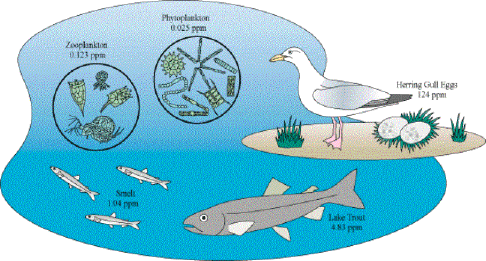
PCBs

#2 – PCBs

During the early 1920s, Monsanto began expanding their chemical production into polychlorinated biphenyls (PCBs) to produce coolant fluids for electrical transformers, capacitors, and electric motors. Fifty years later, toxicity tests began reporting serious health effects from PCBs in laboratory rats exposed to the chemical.
After another decade of studies, the truth could no longer be contained: the U.S. Environmental Protection Agency (EPA) published a report citing PCBs as the cause of cancer in animals, with additional evidence that they can cause cancer in humans. Additional peer-reviewed health studies showed a causal link between exposure to PCBs and non-Hodgkin Lymphoma, a frequently fatal form of cancer.
In 1979, the United States Congress recognized PCBs as a significant environmental toxin and persistent organic pollutant, and banned its production in the U.S.  By then Monsanto already had manufacturing plants abroad, so they weren’t entirely stopped until the Stockholm Convention on Persistent Organic Pollutants banned PCBs globally in 2001.
And that’s when Monsanto’s duplicity was uncovered: internal company memos from 1956 surfaced, proving that Monsanto had known about dangers of PCBs from early on.
In 2003, Monsanto paid out over $600 million to residents of Anniston, Alabama, who experienced severe health problems including liver disease, neurological disorders and cancer after being exposed to PCBs — more than double the payoff that was awarded in the case against Pacific Gas & Electric made famous by the movie “Erin Brockovich.”
And yet the damage persists: nearly 30 years after PCBs have been banned from the U.S., they are still showing up in the blood of pregnant women, as reported in a 2011 study by the University of California San Francisco.

polystyrene-749803

#3 – Polystyrene

In 1941, Monsanto began focusing on plastics and synthetic polystyrene, which is still widely used in food packaging and ranked 5th in the EPA’s 1980s listing of chemicals whose production generates the most total hazardous waste.

#4 – Atom bomb and nuclear weapons

Shortly after acquiring Thomas and Hochwalt Laboratories, Monsanto turned this division into their Central Research Department. Between 1943 to 1945, this department coordinated key production efforts of the Manhattan Project—including plutonium purification and production and, as part of the Manhattan Project’s Dayton Project, techniques to refine chemicals used as triggers for atomic weapons (an era of U.S. history that sadly included the deadliest industrial accident).

DDT is good for me old ad

#5 – DDT

In 1944, Monsanto became one of the first manufacturers of the insecticide DDT to combat malaria-transmitting mosquitoes. Despite decades of Monsanto propaganda insisting that DDT was safe, the true effects of DDT’s toxicity were at last confirmed through outside research and in 1972, DDT was banned throughout the U.S.
Dioxin_chart
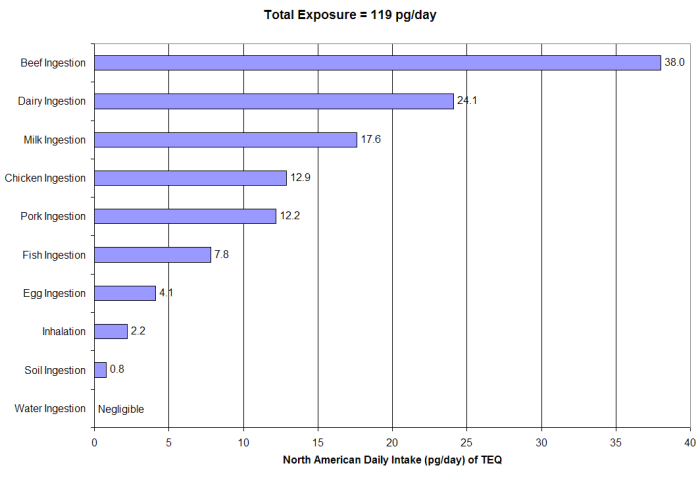
This chart illustrates how much dioxin an average American consumes per day

#6 – Dioxin

In 1945, Monsanto began promoting the use of chemical pesticides in agriculture with the manufacture of the herbicide 2,4,5-T (one of the precursors to Agent Orange), containing dioxin. Dioxins are a group of chemically-related compounds that since become known as one of the “Dirty Dozen” — persistent environmental pollutants that accumulate in the food chain, mainly in the fatty tissue of animals. In the decades since it was first developed, Monsanto has been accused of covering up or failing to report dioxin contamination in a wide range of its products.
Anh Trang Nhan Hoi Anh Orphanage #7 – Agent Orange
During the early 1960s, Monsanto was one of the two primary manufacturers of Agent Orange, an herbicide / defoliant used for chemical warfare during the Vietnam War. Except Monsanto’s formula had dioxin levels many times higher than the Agent Orange produced by Dow Chemicals, the other manufacturer (which is why Monsanto was the key defendant in the lawsuit brought by Vietnam War veterans in the United States).
(Pictured at left, Anh and Trang Nhan, with their father, when they first arrived at the Hoi An Orphanage; below are the same brothers shortly before Trang’s death. Source: Kianh Foundation Newsletter, Dec. 2011)
Agent orange boys orphanageAs a result of the use of Agent Orange, Vietnam estimates that over 400,000 people were killed or maimed, 500,000 children were born with birth defects, and up to 1 million people were disabled or suffered from health problems—not to mention the far-reaching impact it had on the health of over 3 million American troops and their offspring.
agent-orange-children-at-tudu-hospital-in-ho-chi-minh-city Internal Monsanto memos show that Monsanto knew of the problems of dioxin contamination of Agent Orange when it sold it to the U.S. government for use in Vietnam. Despite the widespread health impact, Monsanto and Dow were allowed to appeal for and receive financial protection from the U.S. government against veterans seeking compensation for their exposure to Agent Orange.
In 2012, a long 50 years after Agent Orange was deployed, the clean-up effort has finally begun. Yet the legacy of Agent Orange, and successive generations of body deformitieswill remain in orphanages throughout VietNam for decades to come.
(Think that can’t happen here? Two crops were recently genetically engineered to withstand a weedkiller made with one of the major components of Agent Orange, 2,4-D, in order to combat “super weeds” that evolved due to the excessive use of RoundUp.)

8 – Petroleum-Based Fertilizer

In 1955, Monsanto began manufacturing petroleum-based fertilizer after purchasing a major oil refinery. Petroleum-based fertilizers can kill beneficial soil micro-organisms, sterilizing the soil and creating a dependence, like an addiction, to the synthetic replacements. Not the best addiction to have, considering the rising cost and dwindling supply of oil…

roundup-ready-crops

#9 – RoundUp

During the early 1970s, Monsanto founded their Agricultural Chemicals division with a focus on herbicides, and one herbicide in particular: RoundUp (glyphosate). Because of its ability to eradicate weeds literally overnight, RoundUp was quickly adopted by farmers. Its use increased even more when Monsanto introduced “RoundUp Ready” (glyphosate-resistant) crops, enabling farmers to saturate the entire field with weedkiller without killing the crops.
While glyphosate has been approved by regulatory bodies worldwide and is widely used, concerns about its effects on humans and the environment persist. RoundUp has been found in samples of groundwater, as well as soil, and even in streams and air throughout the Midwest U.S., and increasingly in food. It has been linked to butterfly mortality, and the proliferation of superweeds. Studies in rats have shown consistently negative health impacts ranging from tumors, altered organ function, and infertility, to cancer and premature death. Reference the above “GMO Risks” page which includes countless references to support these statements.

#10 – Aspartame (NutraSweet / Equal)

An accidental discovery during research on gastrointestinal hormones resulted in a uniquely sweet chemical: aspartame. During the clinical trials conducted on 7 infant monkeys as part of aspartame’s application for FDA approval, 1 monkey died and 5 other monkeys had grand mal seizures—yet somehow aspartame was still approved by the FDA in 1974. In 1985, Monsanto acquired the company responsible for aspartame’s manufacture (G.D. Searle) and began marketing the product as NutraSweet. Twenty years later, the U.S. Department of Health and Human Services released a report listing 94 health issues caused by aspartame. (Watch a quick video here.)
rbgh cows

#11 – Bovine Growth Hormone (rBGH)

This genetically modified hormone was developed by Monsanto to be injected into dairy cows to produce more milk. Cows subjected to rBGH suffer excruciating pain due to swollen udders and mastitis, and the pus from the resulting infection enters the milk supply requiring the use of additional antibiotics. rBGH milk has been linked to breast cancer, colon cancer, and prostate cancer in humans.

#12 – Genetically Modified Crops / GMOs

In the early 1990s, Monsanto began gene-splicing corn, cotton, soy, and canola with DNA from a foreign source to achieve one of two traits: an internally-generated pesticide, or an internal resistance to Monsanto’s weedkiller RoundUp. Despite decades of promises that genetically engineered crops would feed the world with more nutrients, drought resistance, or yield, the majority of Monsanto’s profits are from seeds that are engineered to tolerate Monsanto’s RoundUp—an ever-rising, dual income stream as weeds continue to evolve resistance to RoundUp.
Most sobering however, is that the world is once again buying into Monsanto’s “safe” claims.
Just like the early days of PCBs, DDT, Agent Orange, Monsanto has successfully fooled the general public and regulatory agencies into believing that RoundUp, and the genetically modified crops that help sell RoundUp, are “safe.”
Except Monsanto has learned a thing or two in the past 100+ years of defending its dirty products: these days, when a new study proving the negative health or environmental impacts of GMOs emerges, Monsanto attacks the study and its scientist(s) by flooding the media with counter claims from “independent” organizations, scientists, industry associations, blogs, sponsored social media, and articles by “private” public relations firms—frequently founded, funded and maintained by Monsanto.
Unfortunately, few of us take the time to trace the members, founders, and relationships of these seemingly valid sources back to their little Monsanto secret. (Read more on this page.)
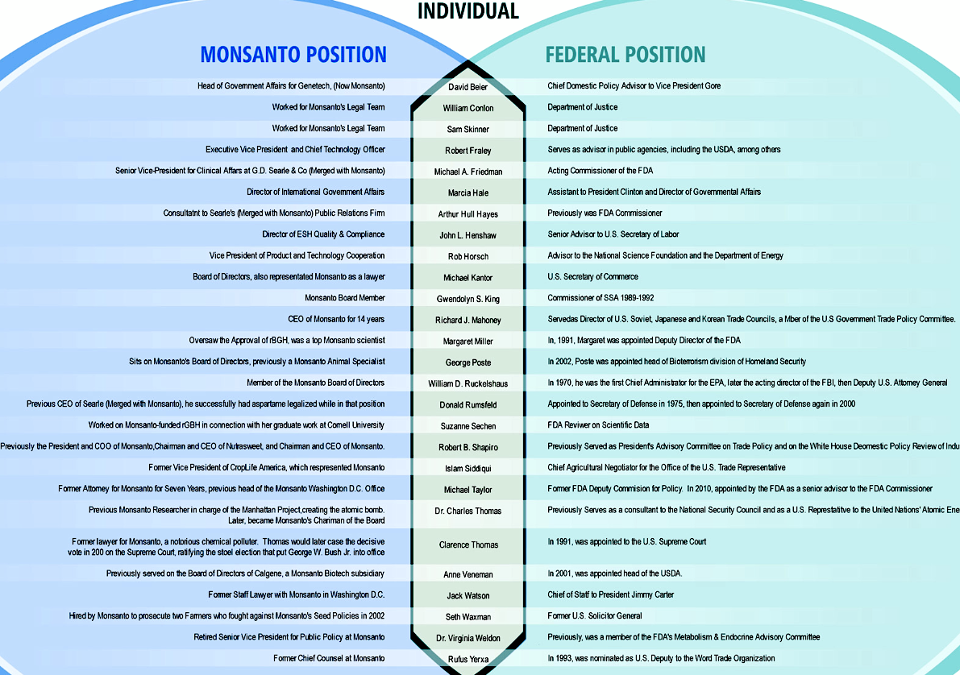
Fooling the FDA required a slightly different approach: click on the below chart compiled by Millions Against Monsanto to see how many former Monsanto VPs and legal counsel are now holding positions with the FDA. And don’t forget Clarence Thomas, former Monsanto attorney who is now a Supreme Court Justice, ruling in favor of Monsanto in every case brought before him.
Monsanto FDA

A Baker’s Dozen: #13 – Terminator Seeds

In the late 1990s, Monsanto developed the technology to produce sterile grains unable to germinate. These “Terminator Seeds” would force farmers to buy new seeds from Monsanto year after year, rather than save and reuse the seeds from their harvest as they’ve been doing throughout centuries. Fortunately this technology never came to market. Instead, Monsanto chose to require farmers to sign a contract agreeing that they will not save or sell seeds from year to year, which forces them to buy new seeds and preempts the need for a “terminator gene.” Lucky for us… since the terminator seeds were capable of cross-pollination and could have contaminated local non-sterile crops.

What’s the Result of our Monsanto Legacy?
Between 75% to 80% of the processed food you consume every day has GMOs inside, and residues of Monsanto’s RoundUp herbicide outside. But it’s not just processed food—fresh fruit and vegetables are next: genetically engineered sweet corn is already being sold at your local grocer, with apples and a host of other “natural” produce currently in field trials.
How is it that Monsanto is allowed to manipulate our food after such a dark product history? How is it they are allowed to cause such detrimental impact to our environment and our health?
According to the Organic Consumers Association, “There is a direct correlation between our genetically engineered food supply and the $2 trillion the U.S. spends annually on medical care, namely an epidemic of diet-related chronic diseases.
Instead of healthy fruits, vegetables, grains, and grass-fed animal products, U.S. factory farms and food processors produce a glut of genetically engineered junk foods that generate heart disease, stroke, diabetes and cancer—backed by farm subsidies—while organic farmers receive no such subsidies.
Monsanto’s history reflects a consistent pattern of toxic chemicals, lawsuits, and manipulated science. Is this the kind of company we want controlling our world’s food supply?
P.S. Monsanto’s not alone. Other companies in the “Big Six” include Pioneer Hi-Bred International (a subsidiary of DuPont), Syngenta AGDow Agrosciences (a subsidiary of Dow Chemical, BASF (which is primarily a chemical company that is rapidly expanding their biotechnology division, and Bayer Cropscience (a subsidiary of Bayer). View a complete list of companies doing genetic engineering on this website.
Follow GMO Awareness on Facebook.

4/18/13

Keystone - A Climate Catastrophe'

"If you really think the environment is less important than the economy, try holding your breath while you count your money." - Dr. Guy McPherson

'Cooking the Books and the Planet': Report Slams State Dept. KXL Findings

'Any objective analysis of the impact of building Keystone shows that it would be a climate catastrophe'

- Jon Queally, staff writer
Students from Santa Monica High School join hundreds of protestors on Feb. 17 at Los Angeles City Hall demanding President Obama to reject the Keystone XL pipeline. (Credit: Charlie Kajio/cc by 2.0)A new report by some of the nation's top environmental groups on Tuesday shows that approval of the Keystone XL tar sands pipeline would add at least 181 million metric tons of carbon dioxide to the atmosphere, the equivalent of pollution from 37.7 million cars or 51 newly built coal-fired power plants.
The report—“Cooking the Books: How The State Department Analysis Ignores the True Climate Impact of the Keystone XL Pipeline” (pdf)—is a direct rebuttal of the government authored environmental impact statement (known as an SEIS) which was released in draft form last month and that environmentalists say is a deeply flawed and short-sighted look at the project, especially as it relates to the science of climate change.
The report was researched and authored by Oil Change International with input and review by the Natural Resources Defense Council, 350.org, Environment America, National Wildlife Federation, Friends of the Earth, the Sierra Club and Greenpeace.

“Any objective analysis of the impact of building Keystone shows that it would be a climate catastrophe,” said Ross Hammond, senior campaigner for Friends of the Earth. “Instead, the State Department seems ready to buy into the pipeline propaganda of an army of lobbyists who are trading on their ties to Secretary Kerry and President Obama to taint the decision. The president must act in the national interest, not the interests of Big Oil, and reject the Keystone XL pipeline.”
The key findings of the group's research concluded that:
  • The 181 million metric tons of (CO2e) from Keystone XL is equivalent to the tailpipe emissions from more than 37.7 million cars. This is more cars than are currently registered on the entire West Coast (California, Washington, and Oregon), plus Florida, Michigan, and New York – combined.
  • Between 2015 and 2050, the pipeline alone would result in emissions of 6.34 billion metric tons of CO2e. This amount is greater than the 2011 total annual carbon dioxide emissions of the United States.
  • The International Energy Agency has said that two-thirds of known fossil fuel reserves must remain undeveloped if we are to avoid a 2 degree C temperature rise. Constructing the Keystone XL pipeline and developing the tar sands make that goal far more difficult, if not impossible, to reach.
Despite all this, said 350.org executive director May Boeve, "the State Department says that the pipeline would have negligible climate impacts."
Boeve's group is among those urging its members this week to use the public comment period set out by the State Department to voice their opposition to the tar sands pipeline and hopes that this new report will help inform the broader public about the inherent dangers of Keystone XL, whether it eventually spills or not.
“The report clearly demonstrates that we can’t protect future generations from the worst impacts of global warming while allowing ourselves to become hooked on even dirtier sources of fuel,” said Daniel Gatti, Get Off Oil Program Director for Environment America. “We need President Obama and Secretary Kerry to say no to tar sands, and no to the Keystone XL pipeline.”
And Inter Press Service adds:
At the heart of this criticism is an observation of conflicting national policies: that approval of the Keystone XL would contradict stated U.S. climate policy.
“At the top of a long list of problems with [the SEIS] is the simple assertion that the Keystone XL pipeline would have no impact on climate change … in the belief that these emissions will be released regardless of whether the pipeline gets built. This is simply incorrect,” Steve Kretzmann, lead author of the new report and a researcher with Oil Change International, an advocacy group, told reporters Tuesday.
"Further, whether or not that oil would be burned anyway is a separate question … The State Department needs to assess this project’s climate impact by looking at whether Keystone XL would survive national policies to limit climate change to two degrees Celsius, which is this country’s stated goal – and we believe it would not.”
Since the Keystone XL proposal was first put forward by TransCanada, a Canadian company, in 2008, scientists have come to a clearer understanding of what’s today called the world’s “carbon budget”. This refers to the percentage of remaining fossil fuel resources that can be burned without bringing about the catastrophic forecasts of what could happen if the Earth’s average temperature rises more than two degrees Celsius by the end of this century.
Also on Tuesday, the public advocacy group Public Citizen released a separate report which debunked another central claim of pipeline proponents—that building Keystone would lower domestic gasoline and fuel prices for US consumers. In fact, claims the group, their findings support the idea that gas prices would almost certainly go up, not down.
According to the group:
Because the pipeline is designed to send oil from Canada to overseas markets (Canadian Energy Minister Ken Hughes recently said that it is a “strategic imperative” to get petroleum products “to the ocean, so that we secure global prices for our products”), it will not enhance U.S. energy security. In fact, a major purpose is to divert tar sands oil from U.S. Midwest refineries, where it is refined and sold in the domestic market, to the Gulf Coast, for export. That means the pipeline will work to raise – not lower – prices for U.S. consumers.
The fact that the oil will be shipped outside the U.S. raises questions about the validity of claims that the pipeline will improve national energy security. In fact, not only will U.S. consumers not see the oil, but much of it will be owned by China, which is the largest foreign investor in Canada’s tar sands, representing 52 percent of all foreign investment since 2003. The report documents the many Chinese companies that have bought into the Canadian tar sands, including China National Offshore Oil Corporation, China National Petroleum Corporation and China Investment Corporation.
“Keystone XL proponents are relying on two key arguments to urge the project to be approved: reduced prices for U.S. consumers and national energy security,” said Tyson Slocum, director of Public Citizen’s Energy Program and report author. “Our analysis shows that the pipeline is almost certain to fail to advance either of these objectives.”

3/19/13

Reverse Climate Change - Green The Deserts

If you havn't been enjoying TED TALKS you should start.  You won't be disappointed.
Here is amazing and simple science - turned on it's head - with dramatic results in just the first year.


3/12/13

Five Poisons of Privatization


It gets more maddening every day. Essential human needs are being packaged into products to be bought and sold. The right to food and water, education, health care, public spaces, and unrestricted speech shouldn't be based on who can pay the most, or on who can generate profits with the slickest marketing pitch.
The free-market capitalism that drives our economy is a doctrine of individuals pursuing profit. Nothing else matters. An executive for Roche, a healthcare company, said "We are not in the business to save lives, but to make money."
With privatization of the common good we risk losing both our heritage and our humanness.
1. The Taking of Public Land

Attempts to privatize federal land were made by the Reagan administration in the 1980s and the Republican-controlled Congressin the 1990s. In 2006, President Bush proposed auctioning off 300,000 acres of national forest in 41 states.

The assault on our common areas continues with even greater ferocity today, as the euphemistic Path to Prosperity has proposed to sell millions of acres of "unneeded federal land," and libertarian groups like the Cato Institute demand that our property be "allocated to the highest-value use." Mitt Romney admitted that he didn't know "what the purpose is" of public lands.

Examples of the takeaway are shocking. Peabody Coal is strip-mining public lands in Wyoming and Montana and making a 10,000% profit on the meager amounts they pay for the privilege. Sealaska is snatching up timberland in Alaska. The Central Rockies Land Exchange would allow Bill Koch to pick up choice Colorado properties from the Bureau of Land Management, while neighboring Utah Governor Gary Herbert sees land privatization as a way to reduce the deficit. Representative Cliff Stearns recommended that we "sell off some of our national parks." One gold mining company even invoked an 1872 law to grab mineral-rich Nevada land for which it stands to make a million-percent profit.

The National Resources Defense Council just reported that oil and gas companies hold drilling and fracking rights on U.S. land equivalent to the size of California and Florida combined. Much of this land is "split estate," which means the company can drill under an American citizen's property without consent. Unrestrained by government regulations, TransCanada was able to useeminent domain in Texas to lay its pipeline on private property and then have the owner arrested for trespassing on her own land, and Chesapeake Energy Corporation overturned a 93-year-old law to frack a Texas residence without paying a penny to the homeowners. Most recently, the oil frenzy in North Dakota has cheated Native Americans out of a billion dollars worth of revenue from drilling leases.

Away from the mountains and the plains, back in the cities of Chicago and Indianapolis and L.A. and San Diego, our streets and parking spaces have been surrendered to corporations until the time of our great-grandchildren, with some of the highest profit margins in the corporate world.

2. Water for Sale

The corporate invasion of the water market is well underway. In May 2000 Fortune Magazine called water "one of the world's great business opportunities..[It] promises to be to the 21st century what oil was to the 20th." Citigroup is on board, viewing water as a prime investment, and perhaps the "single most important physical-commodity based asset class."

The vital human resource of water is being privatized and marketed all over the country. In Pennsylvania and California, the American Water Company took over towns and raised rates by 70% or more. In Atlanta, United Water Services demanded more money from the city while prompting federal complaints about water quality. Shell owns groundwater rights in Colorado, oil tycoon T. Boone Pickens is buying up the water in drought-stricken Texas, and water in Alaska is being pumped into tankers and sold in the Middle East.

A 2009 analysis of water and sewer utilities by Food and Water Watch found that private companies charge up to 80 percent more for water and 100 percent more for sewer services. Various privatization abuses or failures occurred in California, Georgia, Illinois, Indiana, New Jersey, and Rhode Island.

Of course, water monopolization is a global concern, and a life-threatening issue in undeveloped countries, where 884 million people are without safe drinking water and more than 2.6 billion people lack the means for basic sanitation. Whether in the U.S. or in the world's poorest nation, the folly of privatizing water is made clear by the profit-seeking motives of business:

(1) Water corporations are primarily accountable to their stockholders, not to the people they serve.
(2) They will avoid serving low-income communities where bill collection might be an issue.
(3) Because of the risk to profits, there is less incentive to maintain infrastructure.

3. Owning Human Life

Monsanto and their agro-chemical partners call themselves the "life industry."

In 1980 a General Electric geneticist engineered an oil-eating bacterium, effective against oil spills, and in the first case of its kind the Supreme Court ruled that "a live, human-made micro-organism is patentable subject matter." Fifteen years later a World Trade Organization decision allowed plants, genes, and microorganisms to be owned as intellectual property.

The results, not surprisingly, have been disastrous. One-fifth of the human genome is privately owned through patents. Strains of influenza and hepatitis have been claimed by corporate and university labs, and because of this researchers can't use the patented life forms to perform cancer research. Thus the cost of life-preserving tests often depends on the whim (and the market analysis) of the organization claiming ownership of the biological entity.

The results have also been otherworldly. In 1996 the U.S. National Institutes of Health attempted to patent the blood cells of the primitive Hagahai tribesman of New Guinea. U.S. companies AgriDyne and W.R. Grace tried to gain ownership of the neem plant, used for centuries in India for the making of medicines and natural pesticides. Other examples of 'biopiracy': The University of Cincinnati holds a patent on Brazil's guarana seed; the University of Mississippi holds a patent on the Asian spice turmeric.

Most tragically, tens of thousands of Indian farmers, charged for seeds that they used to develop on their own, and forced to repurchase them every year, have been driven to suicide after experiencing crop failures and ruinous debt.

Monsanto is at the forefront of GMO seeds and litigation against vulnerable farmers. To date the company has won over half of its patent infringement lawsuits. The Supreme Court is currently weighing the arguments in Bowman vs. Monsanto, which asks if a company can have a claim on a farmer whose crops were derived from a seed already paid for. More significantly, the question is whether a company can claim the rights to a form of life that has been nurtured by communities of farmers for centuries.

4. Owning the Air

In polluted Beijing, wealthy entrepreneur Chen Guangbiao is selling "fresh air" in a soft drink can for about 80 cents.

While Americans are not yet dependent on (real or imagined) breathing supplements, we have relinquished public access to the air in another important way: the 1996 Telecommunications Act led the way to a giveaway of the transmission airwaves to the broadcast media. Through an effective lobbying campaign the communications industry gained all the benefits of a lucrative public space without even a licensing fee. Objected former Senate Majority Leader Bob Dole, "The airwaves are a natural resource. They do not belong to the broadcasters, phone companies or any other industry. They belong to the American people."

Closely related is our right to freedom of expression on the Internet, which has been repeatedly threatened, despite the presence of existing copyright laws, by aggressive proposals like the Stop Online Piracy Act (SOPA) and the Protect IP Act (PIPA). Privacy is at risk with the Cyber Intelligence Sharing and Protection Act (CISPA), passed in the House despite objections by Ron Paul and others who recognize the "Big Brother" implications of government monitoring of Google and Facebook accounts. The Foreign Intelligence Surveillance Act has facilitated the monitoring of foreign communications in the name of anti-terrorism.

A 2011 UNESCO report offered this worrisome insight: "..the control of information on the Internet and Web is certainly feasible, and technological advances do not therefore guarantee greater freedom of speech."

5. Children as Products

Leading capitalists like Bill Gates and Jeb Bush and Michael Bloomberg and Arne Duncan and Michelle Rhee, who together have a few months teaching experience, have decided that the business model can pump out improved assembly line versions of our children.

Charter schools simply don't work as well as the profitseekers would have us believe. The recently updated CREDO study at Stanford concluded again that "CMOs (Charter Management Organizations) on average are not dramatically better than non-CMO schools in terms of their contributions to student learning." Approximately the same percentages of charters and non-charters are showing improvement (or lack of improvement) in reading and math. In addition, poorly performing charters tend not to improve over time.

Nevertheless, charters remain appealing to poorly informed parents. The schools like to represent themselves as equal opportunity educational options, but the facts state the opposite, as many of them have strict application standards that ensure access to the most qualified students. Funding for such schools drains money out of the public system.

Children are viewed as products in another way -- on the school-to-prison pipeline. Many school districts employ "school resource officers" to patrol their hallways, and to ticket or arrest kids who disrupt the academic routine, no matter the age of the offender or the nature of the "offense":
  • A twelve-year-old was arrested for wearing too much perfume.
  • A five-year-old was handcuffed for committing "battery" on a police officer.
  • A six-year-old was called a "terrorist threat" for talking about shooting bubbles at a classmate.
Along with these bizarre instances is the frightening precedent set by a private prison, Corrections Corporation of America, which despite having no law enforcement authority was allowed to participate in a drug sweep at a high school in Arizona.

An Antidote?

A successful society doesn't derive from a few Ayn-Rand-type individuals. It's the other way around, as philosopher John Deweyreasoned in the 1930s. It's easy to forget that our country's greatest success was due to a collaborative effort in the years during and after World War 2, when advances in manufacturing and technology made us the strongest economy the world had ever seen. It was a shared success. The common good was not for sale.

Paul Buchheit
Paul Buchheit is a college teacher, an active member of US Uncut Chicago, founder and developer of social justice and educational websites (UsAgainstGreed.org, PayUpNow.org, RappingHistory.org), and the editor and main author of "American Wars: Illusions and Realities" (Clarity Press). He can be reached at paul@UsAgainstGreed.org.

3/10/13

Keystone XL - Will Obama Back-Stab The World?

Mar 10, 2013  
Mauna Loa Observatory CO2 readings by year
Given the rigid planning of a president's schedule, it seemed but an unhappy coincidence that President Obama was playing golf with oil industry executives exactly when environmental activists were at the White House, protesting the possible approval of the Keystone XL tar sands pipeline; but the symbolism could not have been more appropriate. With the State Department's release of its Supplemental Environmental Impact Statement (SEIS) on the pipeline, we now know that a shockingly fundamental dishonesty pervades its approach to Keystone. We must hope that the president who has most fully embraced the scientific consensus on climate change will not now embrace his State Department's fundamental dishonesty. More than anything else he does on climate change, President Obama's legacy on climate change will be defined by his decision on Keystone; but much more than his legacy is at stake. If it seemed that the State Department's Keystone SEIS was such a deliberate whitewash to green light the pipeline that it could have been written by industry insiders, that's only because it actually was. Brad Johnson of Forecast the Facts:
The State Department's "don't worry" environmental impact statement for the proposed Keystone XL tarsands pipeline, released late Friday afternoon, was written not by government officials but by a private company in the pay of the pipeline's owner. The "sustainability consultancy" Environmental Resources Management (ERM) was paid an undisclosed amount under contract to TransCanada to write the statement, which is now an official government document. The statement estimates, and then dismisses, the pipeline's massive carbon footprint and other environmental impacts, because, it asserts, the mining and burning of the tar sands is unstoppable.... The documents from the ERM-TransCanada agreement are on the State Department's website, but payment amounts and other clients and past work of ERM are redacted. In the contract documents, ERM partner Steven J. Koster certifies that his company has no conflicts of interest. He also certifies that ERM has no business relationship with TransCanada or "any business entity that could be affected in any way by the proposed work" (notwithstanding the impact statement contract itself). In a cover letter, Koster promises State Department NEPA Coordinator Genevieve Walker that ERM understands "the need for an efficient and expedited process to meet the demands of the desired project schedule."
An investigation by Inside Climate News finds that ERM's report draws from work done by other oil industry contractors, Ensys Energy and ICF International.
What could possibly be wrong with the oil industry writing the Supplemental Environmental Impact Statement of an oil industry project? Join me below the fold and find out.
As Johnson notes in another post, it even gets surreal, as the SEIS emphasizes that the pipeline will be protected from the very climate change impacts the pipeline itself will exacerbate. On page ES-16 of the SEIS, we find (pdf):
The pipeline would be buried deep enough to avoid surface impacts of climate changes (freeze-thaw cycles, fires, and temperature extremes).
Which is very comforting. The SEIS doesn't bother to note that the pipeline itself will make those protections even more necessary, but it's very comforting that those protections will be there. The pipeline's impact on climate change was summarized by John Abraham:
The pipeline is essential for the expansion of tar-sand production. It is estimated that if the pipeline were approved, the rate of bitumen extraction would increase by 36%. What various industry voices have been trying to tell us is that the tar sands are necessary for friendly US-Canada relations, for jobs, and for energy security. What those industry voices have not told us is that approval of the pipeline would be a nail in the coffin of climate change. Tar-sand oil is very hard to remove from the ground; it requires enormous amounts of water and energy just to get it to the surface. As a result, it releases more greenhouse gases than conventional fossil fuels. It really is the dirtiest of the dirty. Approval of the Keystone pipeline will lock us in to decades of dependency on this dirty energy at a time when we need to develop clean sources of energy.
But do the tar sands really matter that much? The answer is clearly yes. Alberta has 1.8tn barrels of oil contained within the tar sands. Extracting and burning all of that tar will cause a global temperature increase of about 0.4oC (0.7oF). That is about half of the warming that humans have already caused. For perspective, according to a recent study, the amount of oil-in-place in the Alberta tar sands is approximately seven times that of Saudi Arabia's proven reserves.
And while the pipeline itself may be protected from the climate disaster it will make so much worse, the people of this world will not be protected; and in January, Lord Stern, who in 2006 led a review that concluded that climate change could displace hundreds of millions of people, cause the extinction of some 40 percent of all species, and cost 5 to 20 percent of global GDP, admitted that he had actually underestimated the damage. The dishonesty of the State Department's SEIS continues with this jaw-dropper:
Spills associated with the proposed Project that enter the environment are expected to be rare and relatively small.
Which would be news to those already impacted by the existing pipeline's neither rare nor relatively small spills. The reaction to the SEIS has been blunt, and Kevin Grandia has compiled a list that must be read in its entirety. Among them have been NRDC Canada Project Director Danielle Droitsch:
A draft environmental review just released by the U.S. State Department for the Keystone XL tar sands pipeline ignores mounting evidence the pipeline is not in the national interest.  NRDC has completed a preliminary review of the Draft Supplemental Environmental Impact Statement and concludes that the State Department failed to account for the pipeline’s impact to water and climate.  There is now significant evidence the Keystone XL tar sands pipeline would help trigger a major expansion to tar sands development leading to a sizeable increase in greenhouse gas emissions. And we know that a spill of tar sands oil from Keystone XL would pose much greater risks to precious waterways across America’s heartland.   Despite this evidence, the State Department found there would be no significant impact to the environment if the pipeline were approved.  We disagree.  President Obama should reject this draft environmental review and tell the State Department to re-examine the evidence that shows the pipeline isn’t good for the climate, or water protection, or energy security.
And Rep. Henry Waxman (D-CA), the Ranking Member on the Energy and Commerce Committee:
The draft impact statement appears to be seriously flawed.  We don’t need this dirty oil.  To stop climate change and the destructive storms, droughts, floods, and wildfires that we are already experiencing, we should be investing in clean energy, not building a pipeline that will speed the exploitation of Canada’s highly polluting tar sands.
And Chief Allan Adam of the Athabasca Chipewyan First Nation (ACFN):
We cannot stress our extreme disappointment with this report.  The fact that the Keystone XL pipeline is deemed as non-consequential and not connected to the unabated expansion of Tar Sands is simply not true. Without adequate roadways to markets the tar sands would be locked in the ground. Industry simply cannot expand without pipelines.  Expansion of the tar sands in my peoples homelands means a death sentence for our way for life, destruction of eco-systems vital to the continuation of our inherent treaty rights and massive contributions to catastrophic global climate change, a fate we all share.
Of course, the Petroleum Institute had a different reaction:
American Petroleum Institute Executive Vice President Marty Durbin welcomed the State Department’s draft Environmental Impact Statement for the new Keystone XL Nebraska route. “No matter how many times KXL is reviewed, the result is the same: no significant environmental impact,” said Durbin. “The latest impact statement from the State Department puts this important, job-creating project one step closer to reality. Nebraska has finished its final Keystone XL assessment and the governor has given it his full support. The last approval needed is by President Obama, and we urge him to do so as soon as possible."
Of course, it's a lie that the pipeline will create significant numbers of jobs. The earlier Environmental Impact Statement estimated no more than 500 to 900 local jobs would be created throughout the entire construction throughout the entire region, and the new SEIS estimates no more than a few dozen permanent jobs, once the pipeline has been built. A 2011 study by the Cornell Global Labor Institute found that Keystone may actually destroy more jobs than it creates, and of course neither the fossil fuels industries, nor apparently the State Department that outsourced the SEIS to the fossil fuels industry, seems to care that the pipeline will damage the economy, overall. Some argue that the tar sands will be exploited with or without U.S. help, but Jane Kleeb of Bold Nebraska explains:
Tarsands does not expand unless Keystone XL is built. The State Department's assumption that tarsands development does not change with or without this pipeline is wrong and laughable. Why would TransCanada spend billions on building the pipeline and millions on lobbying unless this piece of infrastructure is the--not a--but the lynchpin for the expansion of tarsands. Without this pipeline Canada stays at 2 million barrels a day, with it they get 3 million barrels a day. The President has the ability to keep a million barrels of tarsands in the ground a day. With a stroke of a pen he can protect property rights, water and make a dent in climate change. This report is laughable using the wrong assumption and therefore the wrong science.
And even more to the point, if this president and this nation are to be serious about dealing with the climate crisis, he and we cannot make excuses for expanding use of even more difficult and dangerous to extract fossil fuels, when all our focus should be on weaning ourselves of fossil fuels altogether. As the graph at the top of this post indicates, we are nearing a level of 400 parts per million atmospheric carbon dioxide. As Peter Gleick recently explained, the planet has not even approached such a level in at least 800,000 years, and it might not have seen those levels in more than 2.6 million years. We have to act as if climate change is an unprecedented crisis, because in the history of the human species, it is. The four-star commander of U.S. military forces in the Pacific is calling climate change the most likely threat that will cripple the security environment, and the U.S. Navy has for years been planning how to secure an ice free arctic. A new study shows global temperatures are the highest in 4000 years.
It shouldn't need to be said, but finding new and more destructive means of burning fossil fuels is not the answer. It shouldn't need to be said, but a White House that, unlike the Republicans, acknowledges and understands the scientific consensus on climate change has no excuse not to be doing everything it can to address climate change. The president's positive steps, including increased fuel efficiency standards and EPA regulation of emissions, isn't enough. There is no halfway, on climate change. There is no balancing between good policies and terrible policies. As Sen. Bernie Sanders (I-VT) put it:
The president cannot tell us that he is concerned about global warming and approve the Keystone XL project.
If the president is concerned about global warming, he will reject Keystone. If he approves Keystone, all his positive efforts on global warming, both as policy and politics, will be effectively for naught.